
Looking for Software Testing Course in Pimpri Chinchwad for your career or business needs? You can obtain strong programming language and technical development skills with our Software training programs and courses in PCMC. Software Training Institute in PCMC | Software Training Courses in Pimpri. Enroll Now!
Choosing a suitable Software Testing Classes Near Akurdi, Pimpri Chinchwad is not only about learning programming languages. It is also about gaining practical exposure, working on real-world projects, understanding industry requirements, receiving placement assistance, and getting proper guidance from experienced professionals. The training focuses on industry-relevant skills, hands-on practice, and project-based learning to help candidates develop the knowledge and confidence needed to pursue opportunities in the IT industry.
Why Choose Software Testing Training in Pimpri Chinchwad?
Pimpri Chinchwad is closely connected with Pune’s growing education and IT job market. For students and working professionals living in and around PCMC, choosing a training center nearby can make attending classes more convenient. It can also be easier to balance learning with college, work, or other day-to-day commitments.
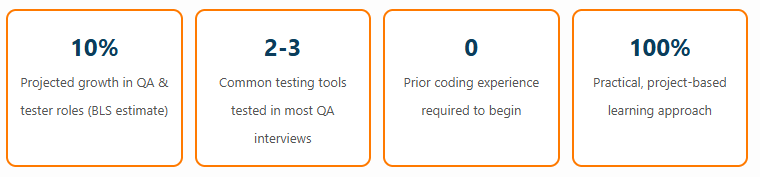
Software testing involves more than merely identifying errors in a program. A QA professional needs to understand how software is developed, plan relevant test scenarios, identify issues, document them properly, and make sure the application works as intended.
When considering Software Testing Classes in Pimpri Chinchwad, pay attention to what you will truly learn and practice during the course. A beneficial program should address topics like:
- Manual and automation testing fundamentals
- SDLC and STLC processes
- Creating and carrying out test scenarios
- Finding, recording, and monitoring flaws
- SQL and database testing
- Java and Selenium automation
- Fundamentals of API and performance testing
- Project-based, hands-on learning
- Resume building and interview preparation
- Career and placement assistance
If software testing is only one of the career paths you are considering, exploring different IT Courses in Pune with Placement can give you a broader idea of the skills, roles, and learning options available in the technology field.
Which Software Testing Skills and Tools Are Covered for QA Jobs?
A software tester needs more than just technical knowledge. Equally crucial are analytical thinking, meticulousness, and the capacity to comprehend how an application functions. For beginners, the learning process should build these skills step by step instead of introducing too many tools and concepts at once.
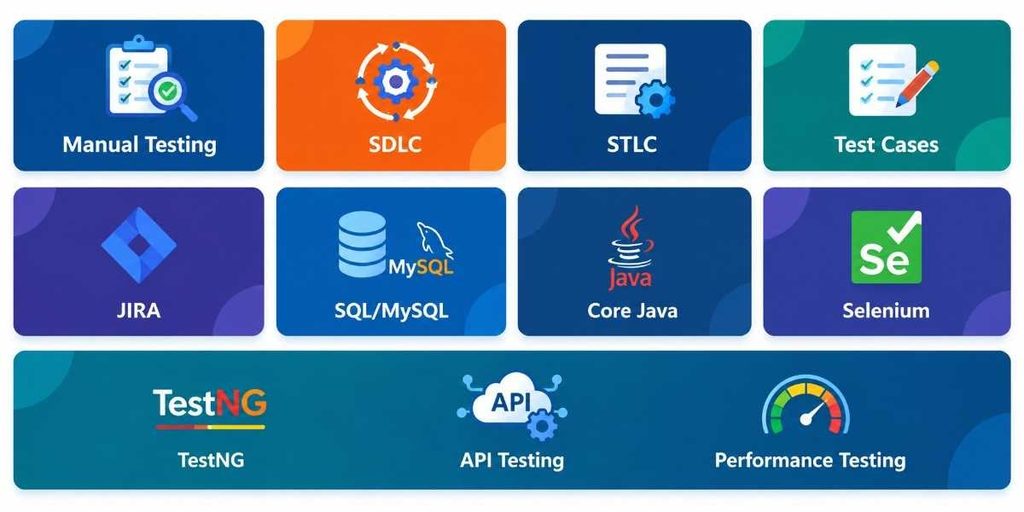
At ProIT Academy, the learning path can be structured around the core areas a beginner needs to understand before moving into automation. It typically starts with manual testing concepts, SDLC and STLC, followed by functional and non-functional testing, test case creation, and defect management. Learners can then move into practical tools and technologies such as JIRA, SQL/MySQL, Core Java, Selenium, and TestNG. API testing and performance testing can further help learners understand how software quality is checked across different stages of development.
| Skill / Tool | How It Is Used in Real Testing Work |
| Manual Testing | Checking whether an application works according to the given requirements |
| SDLC | Learning how software moves from planning and development to release |
| STLC | Understanding the different steps involved in the software testing process |
| Test Cases | Writing clear steps to check different features and user scenarios |
| JIRA | Reporting defects and monitoring their progress until they are fixed |
| SQL/MySQL | Checking database records and verifying whether the stored information is correct |
| Core Java | Developing the programming basics needed for automation testing |
| Selenium | Automating tests for web applications and reducing repetitive manual checks |
| TestNG | Creating, organizing, and running automated test cases more efficiently |
| API Testing | Checking whether different software components communicate and exchange data correctly |
| Performance Testing | Observing how an application performs when different numbers of users or requests are handled |
These skills can help beginners build practical software tester skills for entry-level QA roles. When comparing Software Testing Classes in PCMC, it is useful to look beyond the list of tools mentioned in the syllabus. Good training should also show learners how these skills fit into a real testing process—from understanding requirements and preparing test cases to reporting defects, retesting fixes, and working with automation tools. This practical understanding can be more useful than simply adding a long list of software and technologies to a resume.
Who Can Enroll in Software Testing Classes in Pimpri Chinchwad?
People with a variety of professional and educational backgrounds can think about software testing. It’s not necessary to have years of programming experience to start learning the basics.
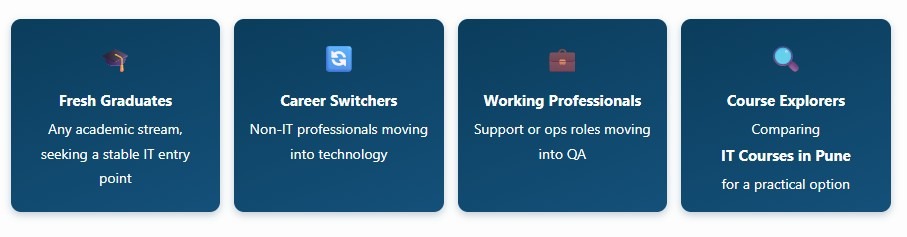
The training can be suitable for:
- Students looking for practical IT skills
- BE/BTech and MCA graduates
- Fresh graduates preparing for their first IT role
- Professionals considering a career transition
- Candidates from non-IT backgrounds
- Career restarters
- Manual testers who want to learn automation
- Developers interested in quality assurance
Someone searching for a Software Testing Course Near Me around PCMC, Bhosari, Akurdi, or nearby areas can compare classroom and online options according to their schedule.
What the Software Testing Course Syllabus Will Teach You?
A good software testing course should take learners step by step, starting with the basics and gradually moving toward automation. The syllabus is structured to help beginners first understand the IT environment and testing concepts, then build the technical knowledge needed to work with databases, Java, and automation tools.
The course covers five key learning areas:
- Basic Foundation Course: The training begins with the essential concepts needed to understand software and the IT industry. This foundation helps beginners become comfortable with basic technical terminology and prepares them for the testing modules that follow.
- Database / MySQL: Testers often need to verify whether information is correctly stored and retrieved from a database. In this module, learners are introduced to MySQL and learn practical database concepts that can be useful while validating application data.
- Basic Software Testing: The fundamental ideas of software testing are covered in this part. Learners understand different testing approaches, how to prepare and execute test cases, identify defects, and follow the software testing life cycle. The focus is on understanding how testing is carried out in a real software development environment.
- Core Java: Java provides the programming foundation required for automation testing. Learners are introduced to important Java concepts and gradually build the programming understanding needed to work with Selenium.
- Selenium Automation Testing: After developing a foundation in testing and Java, learners move into web automation using Selenium. They learn how automated test scripts can be created and executed for web applications, giving them practical exposure to automation testing.
Additionally, learners are exposed to tools like TestNG, Selenium, and JIRA. Database concepts using SQL/MySQL and programming fundamentals using Core Java can provide a foundation for automation testing.
Moving from “What is testing?” to “How would I test this application in a real project?”

Choose Flexible Timings for Software Testing Classes in PCMC
Regular practice becomes easier when class schedules fit around college or employment. For many learners, timing is just as important as the syllabus. College students may have lectures during the day, while working professionals may only have evenings or weekends available. Recorded sessions are also mentioned for revision and flexible learning. Flexible batches can make consistent learning easier. Available formats may include:
- Weekday batches
- Weekend batches
- Classroom sessions
- Live online classes
- Hybrid learning
- Recorded sessions for revision
This flexibility can be particularly useful for learners searching for Software Testing Classes in PCMC or Software Testing Classes Near Akurdi while continuing their existing studies or jobs. Before joining, check the current batch schedule and whether the selected format provides enough time for practical exercises and project work.
Software Testing Course Fees in Pimpri Chinchwad
There is no single fee that applies to every software testing program. Pricing can differ depending on course duration, learning format, syllabus, project work, and career-support services. Instead of choosing a course based only on its fee, compare what is included in the overall package. Think about asking:
- Are there any real-world projects in the course?
- Are automation tools covered?
- Is certification included?
- Are mock interviews provided?
- Is resume guidance available?
- Does the institute offer placement assistance?
- Are flexible payment or EMI options available?
This approach gives a clearer picture of the value of a software testing course with placement rather than comparing numbers alone.
Learn Software Testing in Pimpri Chinchwad Through Practical Projects
Learning software testing becomes more meaningful when students get an opportunity to work on projects instead of only studying concepts. Practical project work helps learners understand how testing tools and frameworks are connected and how a tester approaches tasks in a real development environment. The training includes hands-on work through a POM Framework-Based Project and an Industry-Based Software Testing Project. These projects allow learners to apply the concepts covered during the course and gain experience with commonly used testing tools.
1. POM Framework-Based Project
The Page Object Model (POM) project gives learners practical experience in creating a structured Selenium automation framework. Rather than writing all test steps in one place, POM encourages testers to keep application page elements and test logic organized, making automation scripts easier to maintain. During the project, learners can apply tools and concepts such as:
- Selenium: Automating web application test scenarios
- TestNG: Managing and executing automated test cases
- Maven: Managing project dependencies and builds
- Cucumber: Writing test scenarios in a readable format
- Jenkins: Running automation tests as part of a continuous integration workflow
- Selenium Grid: Running tests across different browsers or environments
- Framework Design: Organising reusable components for maintainable automation
Working with these tools together helps learners understand that automation is not just about writing Selenium scripts. They also need to structure the framework, manage dependencies, execute tests efficiently, and maintain the automation suite as the application changes.
2. Industry-Based Software Testing Project
The industry-based project gives learners an opportunity to work with testing scenarios that are closer to the type of situations they may encounter in a professional QA environment. The project work follows the course curriculum and focuses on applying testing concepts to real-time use cases. Learners can practise activities such as:
- Understanding requirements and identifying test scenarios
- Preparing and executing test cases
- Finding and documenting defects
- Performing different types of testing based on project requirements
- Using testing tools as part of the project workflow
- Retesting fixes and checking for related issues
- Applying automation concepts where appropriate
- Discussing project outcomes and testing observations
The main benefit of these projects is that learners get to connect individual topics with a complete testing workflow. Someone searching for Software Testing Training in PCMC or Software Testing Training Near Bhosari, can therefore look beyond classroom theory and consider whether the program provides meaningful project exposure. That practical understanding can make your software tester skills easier to demonstrate to potential employers. This type of experience can help candidates explain their work during interviews and build relevant skills for resume development.
How long does the training for software testing last?
The software testing training is designed to run for around five months, giving learners enough time to understand testing basics and practice them through projects. The course may include:
- Testing both manually and automatically
- Selenium, TestNG, and Core Java
- SQL/MySQL and database testing
- Practical testing projects
- Interview and career preparation
The exact schedule may vary by batch, so learners should confirm the latest duration and class timings before joining.
Know Your Trainers: Making Software Testing Easier to Learn
For beginners, the way a trainer explains a topic can make a big difference. Concepts such as regression testing, test cases, defect life cycle, automation frameworks, and API testing can feel difficult at first. A trainer with practical experience can make these topics easier by connecting them with situations that testers commonly face at work.
For example, instead of only learning the definition of regression testing, learners can understand why an already-working feature needs to be tested again after a new change is made. When comparing a Best Software Testing Institute in Pune, consider these trainer-related factors:
| What to Examine | Why It’s Important |
| Experience in the Industry | Helps connect lessons with real testing situations |
| Practical Demonstrations | Makes tools and concepts easier to understand |
| Project Guidance | Helps learners apply what they study |
| Doubt-Solving Support | Gives learners confidence to ask questions |
| Interview Preparation | Helps explain testing concepts and projects clearly |
A supportive trainer should encourage questions, explain concepts in simple language, and guide learners when they get stuck during practical work. This can make the overall learning experience more comfortable, especially for students and beginners entering software testing for the first time.
When comparing the Best Software Testing Institute in Pune for a Software Testing Course with Placement, look at the trainer’s industry experience, teaching style, practical demonstrations, project guidance, doubt-solving support, and interview preparation. A good learning environment should encourage questions and help students understand not just how testing is done, but why a particular testing approach is used in real projects.
Get Placement Support After Completing Software Testing Training in PCMC
Completing software testing training is a good starting point, but it does not automatically lead to a job. Candidates also need to show that they can apply their knowledge, explain their projects, and handle practical questions during interviews. This is where software testing training and placement support can be helpful.

Placement assistance may cover areas such as:
- Resume preparation: Presenting your testing skills, tools, and project work clearly
- Mock interviews: Practising common technical and HR interview questions
- Interview guidance: Learning how to explain testing concepts and project experience
- Career counselling: Understanding suitable QA roles and possible career paths
- Job assistance: Getting guidance about relevant software testing opportunities
Additionally, it’s critical to comprehend the distinction between a software testing course with job guarantee and placement aid. Before enrolling, candidates should check exactly what placement support includes rather than relying only on the word “guarantee.” Your own preparation matters too. Understanding the software testing job profile, explaining your project confidently, and answering situation-based questions can make interviews much easier to handle. For extra practice, learners can go through Top 50 Software Testing Interview Questions to revise important concepts and prepare for common QA interview discussions.
Frequently Asked Questions
1. How long does a Software Testing Course in Pimpri Chinchwad last?
Depending on the curriculum and practical content, a Software Testing Course in Pimpri Chinchwad may take a few weeks to many months. A detailed program may include manual testing, automation, SQL, Java, Selenium, projects, and interview preparation. Learners should check the latest batch schedule before enrolling.
2. Who is eligible to enroll in Software Testing Classes in Pimpri Chinchwad?
Software Testing Classes in Pimpri Chinchwad can be suitable for fresh graduates, students, working professionals, career changers, and candidates from non-IT backgrounds. Basic computer knowledge can be helpful, while programming experience is not always required to start learning software testing.
3. Does a Software Testing Course include placement support?
Some programs offer a Software Testing Course with Placement support that may include resume guidance, mock interviews, career counselling, and assistance with relevant job opportunities. Candidates should check exactly what the placement support covers rather than assuming that it means a guaranteed job.
4. What skills are taught in Software Testing Training in PCMC?
Software Testing Training in PCMC may cover manual testing, SDLC, STLC, test case preparation, defect management, SQL/MySQL, Core Java, Selenium, TestNG, API testing, and performance testing. Practical projects can also help learners develop software tester skills that they can discuss during interviews.
5. How do I choose a Software Testing Course Near Me?
When searching for a Software Testing Course Near Me, compare more than location and fees. Check the syllabus, trainer experience, practical projects, class timings, learning format, tools covered, certification, and placement assistance. Learners near Bhosari or Akurdi can also compare options offering Software Testing Training Near Bhosari or Software Testing Classes Near Akurdi.
6. Is a profession in software testing a good fit for novices?
Software testing can be considered by beginners who enjoy finding problems, analyzing applications, and checking whether software works as expected. A structured software testing certification course can help build foundational knowledge, while projects and interview practice can provide additional preparation for entry-level QA roles. Before choosing a course, consider its practical learning approach and how well it matches your career goals.
Conclusion
Software testing can be a practical career option for learners who enjoy analyzing applications, identifying problems, and thinking from a user’s perspective. A structured Software Testing Course in Pimpri Chinchwad can help learners build knowledge of manual testing, automation, SQL, Java, Selenium, API testing, and other QA practices while gaining hands-on project experience.
When choosing training, look beyond the course name. Compare the syllabus, trainer experience, practical exposure, timings, fees, certification, projects, and placement assistance. A software testing certification course can add value to your profile, but your actual skills and ability to demonstrate them in an interview remain important.
For learners exploring QA as part of their IT career journey, ProIT Academy can also serve as an educational resource for strengthening software testing knowledge and interview preparation. The right learning approach is ultimately one that helps you understand testing practically, build confidence through practice, and prepare realistically for the expectations of QA roles.