Python is widely used in web development, automation, data analysis, and artificial intelligence. If you are preparing for a technical interview in 2026, practising common Python interview questions and answers can help you explain concepts clearly and solve coding problems with confidence.
Whether you are a fresher or an experienced developer, this guide covers important questions, simple explanations, and practical examples to help you prepare for interviews. It also helps students searching for Python classes in Pune understand which programming concepts they should focus on before applying for jobs.
Python Interview Questions and Answers for Freshers
Freshers are usually tested on Python basics, data types, functions, loops, and object-oriented programming. Interviewers want to know whether you understand the concepts and can use them to solve simple problems.
1. What is Python, and what are its main features?
Answer: Python is a high-level, general-purpose programming language known for its simple syntax and wide range of applications.
Important features of Python include:
- Easy to learn: Its readable syntax helps beginners understand code.
- Dynamically typed: It is not necessary to declare the type of a variable before.
- Large library support: Python offers tools for web development, automation, and data analysis.
- Cross-platform: Python applications are compatible with a variety of operating systems.
- Object-oriented: It supports classes, objects, inheritance, and other OOP concepts.
Example: Python can automate repetitive office tasks, build websites, and process business data.
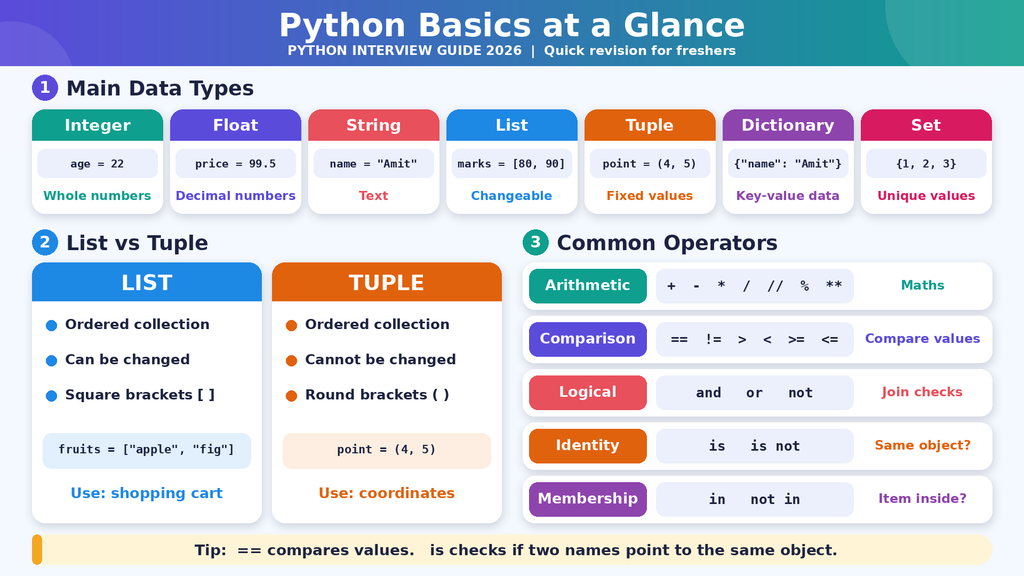
2. Which Python data types are the most common?
Answer: Data types provide a kind of value that can be stored in a variable. Common data types in Python include:
| Data type | Example | Use |
| Integer | age = 22 | Stores whole numbers. |
| Float | price = 99.5 | Stores decimal numbers |
| String | name =”Amit” | Stores Text |
| List | marks = [80, 90] | Stores changeable collections |
| Tuple | point = (4, 5) | Stores fixed collections |
| Dictionary | {“name”: “Amit”} | Stores key-value data |
| Set | {1, 2, 3} | Stores unique values |
Understanding these types helps you choose the right structure when writing programs.
3. What is the distinction between a tuple and a list?
Answer: A list and a tuple both store multiple values, but their main difference is that a list is changeable, while a tuple is not.
List: A list is an ordered collection that allows you to add, remove, or update items after creation.
Example:

Output:

Tuple:A tuple is an ordered collection that, once created, cannot be altered.
Example:

Output:

Key difference: Use a list when the data needs to change, such as a shopping cart. Use a tuple when the collection should remain fixed, such as a pair of coordinates.
4. What is the distinction between ‘is’ and ‘==’?
Answer: Both operators are used for comparisons, but they check different things.
- == (Equality operator): Checks whether two objects have equal values.
- is (identity operator): determines whether two pointers correspond to the same memory object.
Example:
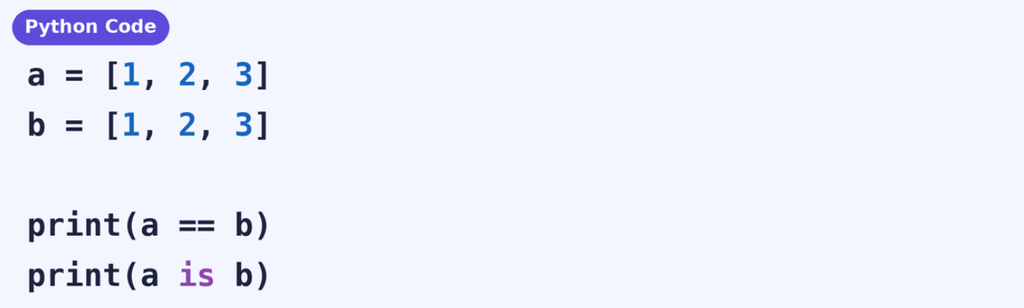
Output:

Both lists contain the same values, so a == b returns True. However, they are two separate list objects, so a is b returns False.
Interview tip: Use == to compare values and is None when checking whether a variable contains None.
5. What are functions, and what is their purpose?
Answer: Functions are reusable code segments with specified functions. They make programs easier to test, read, and maintain.
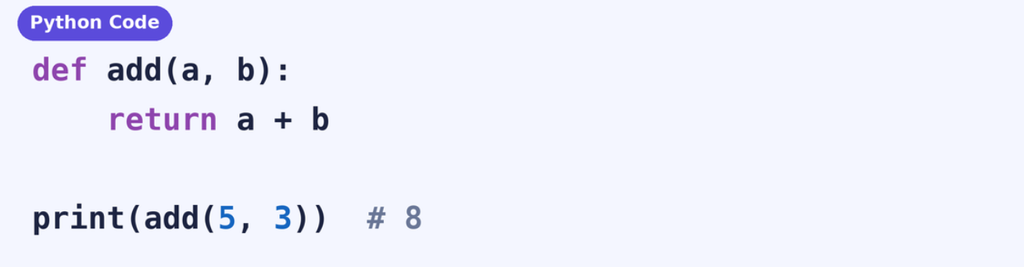

When the same calculation needs to be done multiple times, a function can be helpful. Instead of repeating code, you can call the function whenever needed.

Python Interview Questions and Answers for Experienced Professionals
Experienced candidates are often asked about code quality, performance, memory use, and object-oriented programming. Additionally, they might have to describe how they applied these ideas to actual projects.
Beyond interview preparation, understanding the right skills, practical projects, and career opportunities can help you take the next step in your journey. Learn How to build a career as a Python developer and prepare for long-term growth in the IT industry.
6. How do local and global variables differ from one another?
Answer: In Python, variables are classified as local or global based on where they are defined and where they can be accessed.
| Feature | Local Variable | Global Variable |
| Definition | Defined inside a function. | Defined outside a function. |
| Scope | Normally accessible only inside the function where it is defined. | Accessible throughout the module, including inside functions. |
| Example | name = “Rahul” inside a function. | company = “ABC Tech” outside a function. |
| Usage | Used for temporary data within a function. | Used for values shared across different parts of a module. |
| Modification | Can be changed within its local scope. | Use the global keyword to reassign it within a function. |
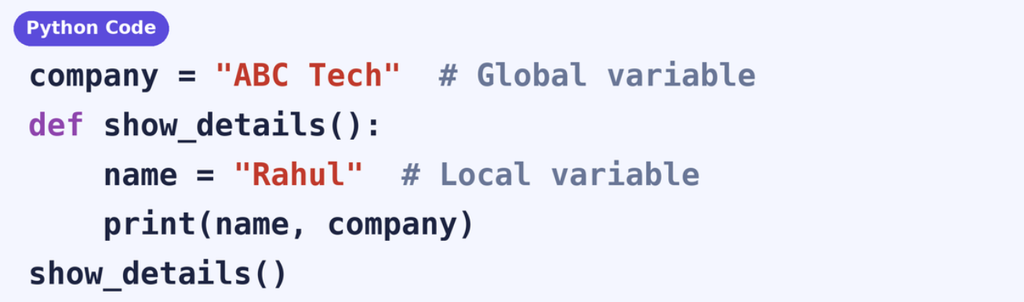
Example:
Output:

Explanation: Here, name is a local variable because it is defined inside the show_details() function. The company variable is global because it is defined outside the function.
Interview Tip: Prefer local variables when possible because they make code easier to manage, test, and debug. Use global variables carefully to avoid unexpected changes.
Enhance your Python skills at Python Classes in Pune.
7. What are decorators in Python?
Answer: Without altering the source code, a decorator gives a function or method additional functionality.
For example, decorators can measure execution time, check permissions, or log function calls. They are commonly used in web frameworks and application monitoring.
8. What is a generator in Python?
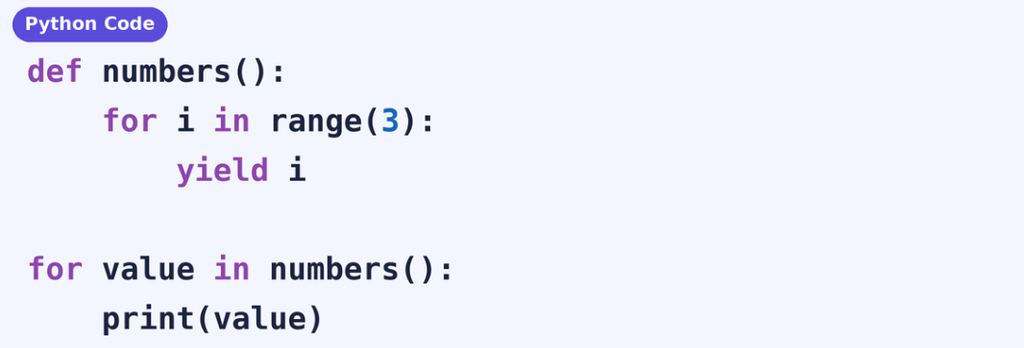
Answer: Instead of generating the entire collection at once, a generator uses the yield keyword to produce values one at a time.
Example:
Output:

Generators are helpful when processing large files or datasets because they can reduce memory usage.
9. What is the difference between multithreading and multiprocessing?
Answer: Multithreading uses multiple threads within one process, while multiprocessing uses separate processes.
| Feature | Multithreading | Multiprocessing |
| Best suited for | Many waiting tasks, such as network requests | CPU-heavy work |
| Memory | Threads share process memory | Processes have separate memory spaces |
| Common use | Downloading multiple files | Running independent calculations |
In standard CPython builds, the Global Interpreter Lock (GIL) limits simultaneous execution of Python bytecode by multiple threads. I/O-bound work can still benefit from threads. Multiprocessing can help with CPU-heavy work, although the best choice depends on the workload.
2026 update: Python 3.14 includes improvements to free-threaded builds and introduces InterpreterPoolExecutor. These are useful advanced topics, but interview preparation should still begin with core Python concepts.
Students planning a Python career should combine technical knowledge with hands-on projects. ProIT Academy offers a training option for learners who want structured guidance and practical programming experience. Before enrolling, evaluate the project work, trainer expertise, placement assistance, and syllabus for Python classes near me.
Python Coding Interview Questions with Answers
Coding rounds test your ability to turn a problem into working code. Practise explaining your logic before writing the solution.
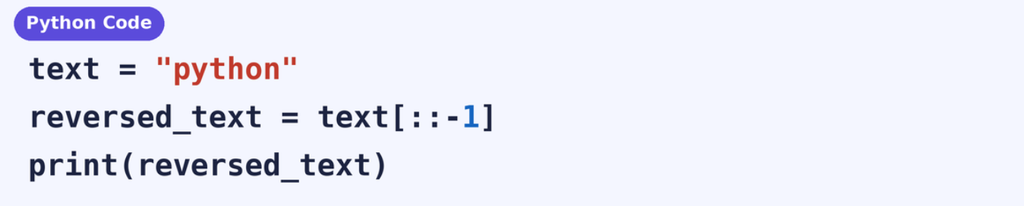
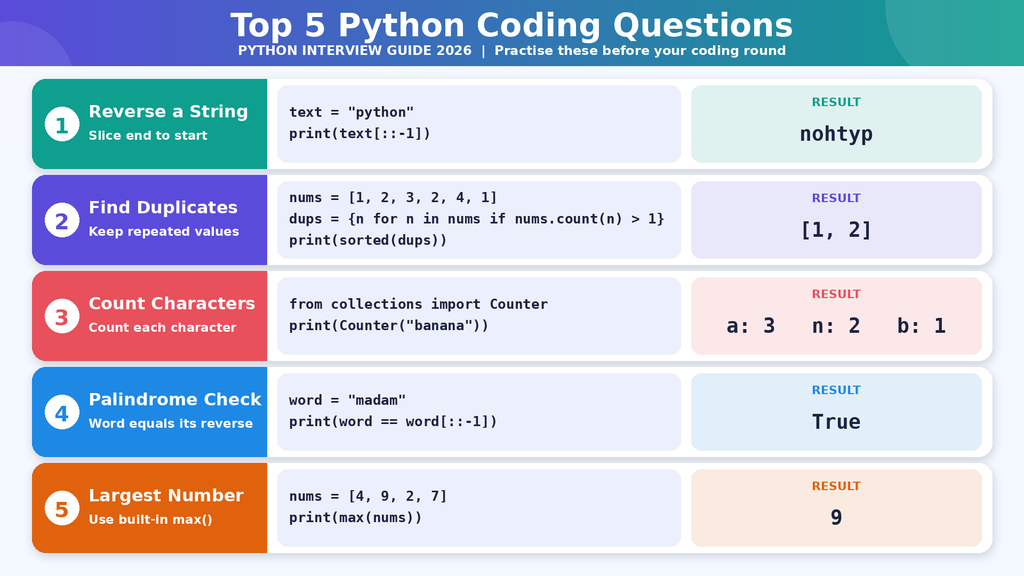
10. In Python, how do you reverse a string?
Answer:
Output:

The slice [::-1] reads the string from the end to the beginning. It is a short and useful solution for reversing strings.
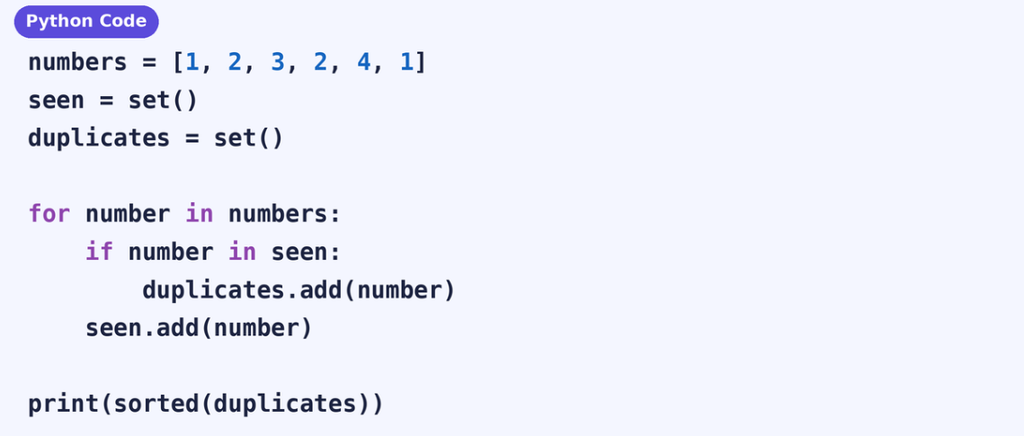
11. How do you find duplicate values in a list?
Answer:
Output: 
The seen set stores values already processed. If a number appears again, it is added to duplicates. This approach is useful for checking repeated IDs, records, or values in datasets.
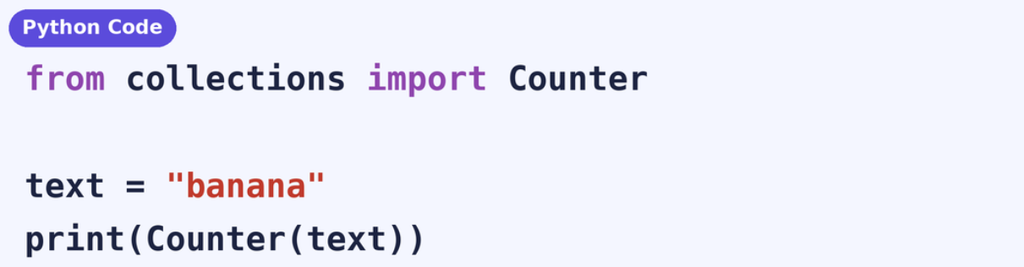
12. How can the frequency of every character in a string be determined?
Answer:
Output:

Counter counts how often each item appears. It is useful for analysing text, counting categories, and summarising data. Python’s standard library also provides specialised containers for common data-handling tasks.

Scenario-Based Python Interview Questions and Answers
Scenario-based questions test how you apply Python knowledge to real work. Interviewers may ask you to explain your decisions, not just provide code.
13. How would you manage a big CSV file if you didn’t want to load everything into memory?
Answer: Read the file in smaller chunks or process it line by line. For example:
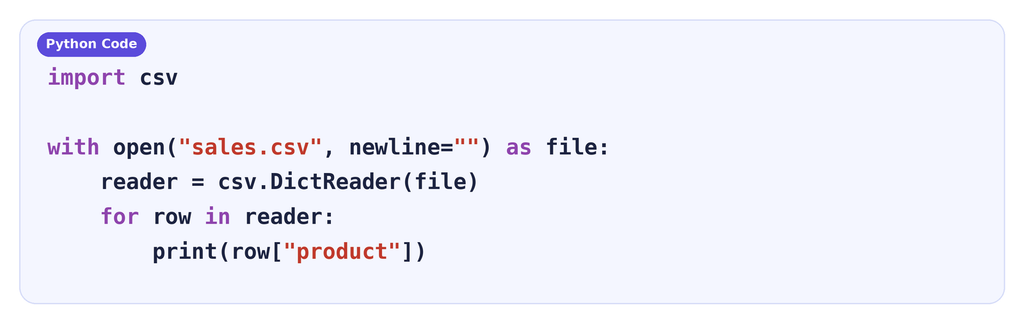
This approach processes records one at a time instead of storing the entire file in a list. For large datasets, it can help control memory use.
14. What would you do if your Python application became slow?
Answer: First, measure performance instead of guessing. Then:
- Use profiling tools to find functions that are slow.
- Examine network calls and database queries.
- Avoid repeated calculations where results can be reused.
- Choose suitable data structures.
- Add caching only where it helps and remains correct.
- Test performance after making changes.
For example, repeatedly removing items from the start of a list can be inefficient. Python’s collections.deque is designed for efficient additions and removals at both ends.
15. How would you manage errors when processing user input?
Answer: Validate the input and use exception handling for errors that may occur.
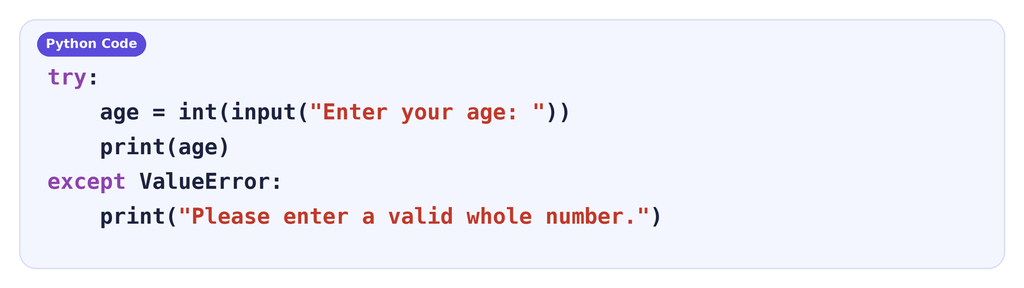
This prevents invalid numeric input from stopping the program unexpectedly. In real applications, log useful error details and avoid exposing sensitive information.
Students who want to build practical projects and prepare for a Python career should practise these problems regularly. At ProIT Academy, learners can connect classroom concepts with hands-on coding practice, industry-relevant projects, and interview preparation. Students exploring IT Courses in Pune With Placement can benefit from structured learning, mentor guidance, practical assignments, and career-focused training that helps them develop the skills needed to pursue opportunities in the IT industry.
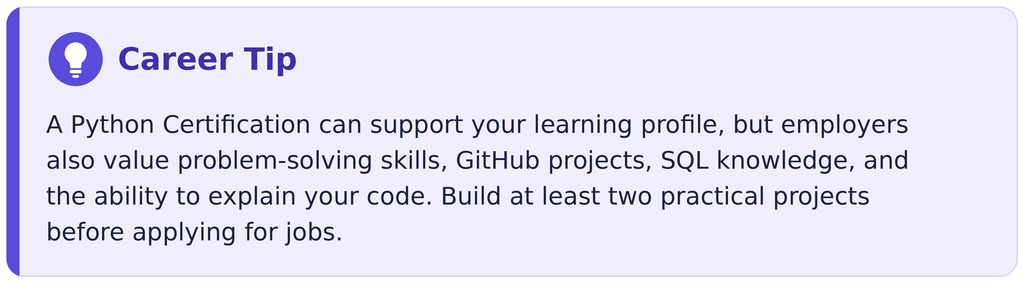
How to Get Ready for Interviews in Python in 2026
Use this easy preparation strategy:
- Revise fundamentals: Study data types, loops, functions, exceptions, and OOP.
- Practise coding daily: Solve string, list, dictionary, and basic algorithm problems.
- Build projects: Try a web application, an automation tool, or a data analysis project.
- Review your code: Practise explaining time complexity, edge cases, and design choices.
- Prepare for practical discussions: Be ready to explain a bug you fixed or a project challenge you solved.
Python’s official documentation is a reliable reference for checking language behaviour and standard-library features. Use the Python tutorial and What’s New in Python 3.14 alongside interview practice.
Conclusion
Preparing for Python interviews in 2026 requires a clear understanding of concepts, regular coding practice, and the ability to explain real-world solutions. Freshers should focus on fundamentals, while experienced candidates should prepare for performance, debugging, and application design questions. If you are building your skills through Python classes near me, remember that practical projects and consistent practice matter as much as classroom learning.
Frequently Asked Questions
1. Which Python interview questions are most frequently asked of freshers?
Freshers should focus on data types, functions, loops, OOP, exception handling, and basic coding problems. Practising these topics with examples helps build confidence for technical interviews.
2. Does ProIT Academy provide Python interview preparation?
Yes, ProIT Academy helps learners prepare for Python interviews through technical concepts, coding practice, and career-focused learning. Contact the academy to learn more about its current training and interview preparation support.
3. To become a Python developer, what skills are required?
Python developers benefit from learning SQL, Git, debugging, testing, and frameworks like Django or Flask. Practical projects help in developing skills for development work in the real world.
4. How should I get ready for a Python coding interview?
Practise string manipulation, lists, dictionaries, loops, and basic algorithms regularly. Understand your code and learn to explain your logic clearly during interviews.
5. How can I pick the best Python classes near me?
When searching for Python classes near me, compare the syllabus, hands-on projects, trainer experience, and interview preparation. Check student reviews and placement support before enrolling.
Join us for more Job Oriented Courses like Python